Enterprise Drupal Cloud Modernization & DevSecOps
Modernize Drupal with greater infrastructure control, portability, automation, security, and operational transparency.
LABUSA helps organizations move complex Drupal environments from proprietary or legacy hosting platforms into modern cloud and hybrid-cloud architectures designed around infrastructure ownership, Infrastructure as Code, automated delivery, Drupal lifecycle management, security, observability, resilience, and managed operations.
Why organizations modernize enterprise Drupal
Organizations rarely decide to leave a Drupal hosting platform because of one failure. They decide because a series of ordinary requests keep meeting the same answer: not on this platform, or not without a ticket, or not at that price.
The pressure usually shows up in a recognizable set of places.
- Infrastructure the organization pays for but cannot inspect, size or reason about.
- Cost that is difficult to attribute to a site, an environment or a workload.
- Deployment steps that cannot be changed because the platform owns them.
- Automation that stops at the boundary of what the vendor chose to expose.
- Scaling decisions taken by somebody else, on a schedule the organization does not set.
- Security and audit visibility that ends where the platform begins.
- Integrations constrained by what the runtime is permitted to reach.
- A growing sense that leaving would be difficult, which is itself the finding.
None of that is an argument against managed platforms, which solve real problems and solve them well for many organizations. It is an argument for deciding deliberately, because the decision is an architecture and operating model decision rather than a hosting change.
A modern Drupal platform is not merely a collection of cloud resources. It is an operating model that combines infrastructure, deployment automation, application lifecycle management, security, observability, resilience, and support.
Cloud resources stay in your account
The subscription, the billing, the identity boundary and the audit trail belong to the organization. Anyone operating the platform does so inside that boundary rather than instead of it.
Code stays portable
The application is a standard Drupal codebase managed with Composer, which describes itself as a tool for dependency management in PHP. What the platform adds should sit around the application rather than inside it.
Configuration stays version controlled
Site configuration lives in the repository and is imported on deploy, so an environment can be rebuilt from what is written down rather than from what somebody remembers doing.
Infrastructure stays declared
The environment is defined in code that the organization holds, so a second region, a recovery environment or a replacement account is a repeat of a known procedure.
Documentation stays available
Runbooks, diagrams and decisions are deliverables, not tribal knowledge held by whoever is on the account this quarter.
Dependencies stay deliberate
Using a managed database, a managed cache or an edge platform is a reasonable engineering choice. Depending on one in a way nobody wrote down is not.
What portability is not
Portability does not mean migration is effortless. It means the architecture avoids unnecessary dependencies that make future change harder than it needs to be.
Edge
CDN, WAF and DDoS protection at the front, on a platform the organization has approved. This is where most traffic should be answered and most hostile traffic should stop.
Load balancing
Distribution across application instances, with health checks that know what a healthy Drupal response actually looks like.
Drupal application runtime
PHP, the web server and the Drupal codebase, deployed as an artifact rather than assembled in place.
Environments
Development, staging and production built from the same definitions, so what passes in staging is a real rehearsal of production.
Data services
Database, file storage, search and cache. The parts that hold state, and therefore the parts that decide what recovery means.
Security services
Identity, secrets, certificates, logging and the path by which security events reach the people who watch them.
Observability
Metrics, logs, traces, synthetic checks and alerting, covering infrastructure and application together.
Protection and recovery
Backup, retention, restore rehearsal and a documented recovery procedure with owners.
Automation and delivery
The pipelines, provisioning and lifecycle tooling that make every layer above repeatable.
One model, several legitimate implementations
Implementations may use public cloud, private cloud, hybrid arrangements, infrastructure the organization already controls, an approved edge platform, or managed services. No single vendor stack is mandatory, and this page does not present one.
Azure DevOps: workflow and delivery control
Source control, pull requests, build, test, security gates, artifacts, approvals, release promotion, deployment orchestration and rollback. Microsoft describes Azure Pipelines as combining continuous integration, continuous testing and continuous delivery to automatically build, test, and deploy code projects to any destination. That last phrase is the one that matters here: the delivery plane does not have to come from the same vendor as the target cloud.
Terraform: infrastructure definition
HashiCorp describes Terraform as an infrastructure as code tool that lets you build, change, and version cloud and on-prem resources safely and efficiently. It is how networking, compute, database, storage, security and backup resources come to exist, repeatably, in an account the organization owns.
Drush: Drupal lifecycle operations
Drush describes itself as a command line shell and Unix scripting interface for Drupal. It performs the operations only Drupal can perform. Its own deploy command standardizes how Drupal deployments work by running database updates, configuration import, cache rebuild and deployment hooks in a defined order.
The delivery plane and the target cloud are separate decisions
Azure DevOps can act as the application delivery and DevSecOps control plane while Drupal workloads run in AWS, in private infrastructure, or across a hybrid environment. Terraform alone is not a replacement for a managed Drupal platform, and neither is any other single tool.
Infrastructure provisioning
Infrastructure as Code, held by the organization, applied through a pipeline rather than by hand.
Code deployment and environments
A pipeline that builds an immutable artifact once and promotes that same artifact through every environment, and that can create and tear down environments from the same definitions used for production.
Drupal lifecycle and bulk operations
Drush and scripted operations for updates, configuration import, cache and maintenance, able to act across a whole estate and report what succeeded.
Monitoring and self-service
Cloud native metrics plus open observability covering the application, and a catalog that exposes approved actions to delivery teams without granting infrastructure access.
Backup and recovery
Automated backup, defined retention, and restore rehearsed on a schedule rather than assumed.
Security and operations
Identity, secrets, WAF, centralized logging, a route into security monitoring, and somebody accountable for the platform on an ordinary Tuesday and on a bad Sunday.
The replacement is a platform, not a product
The replacement is the integrated operating platform, not a single tool. An estate that automates provisioning brilliantly and leaves restore untested has not finished.
Discover and classify
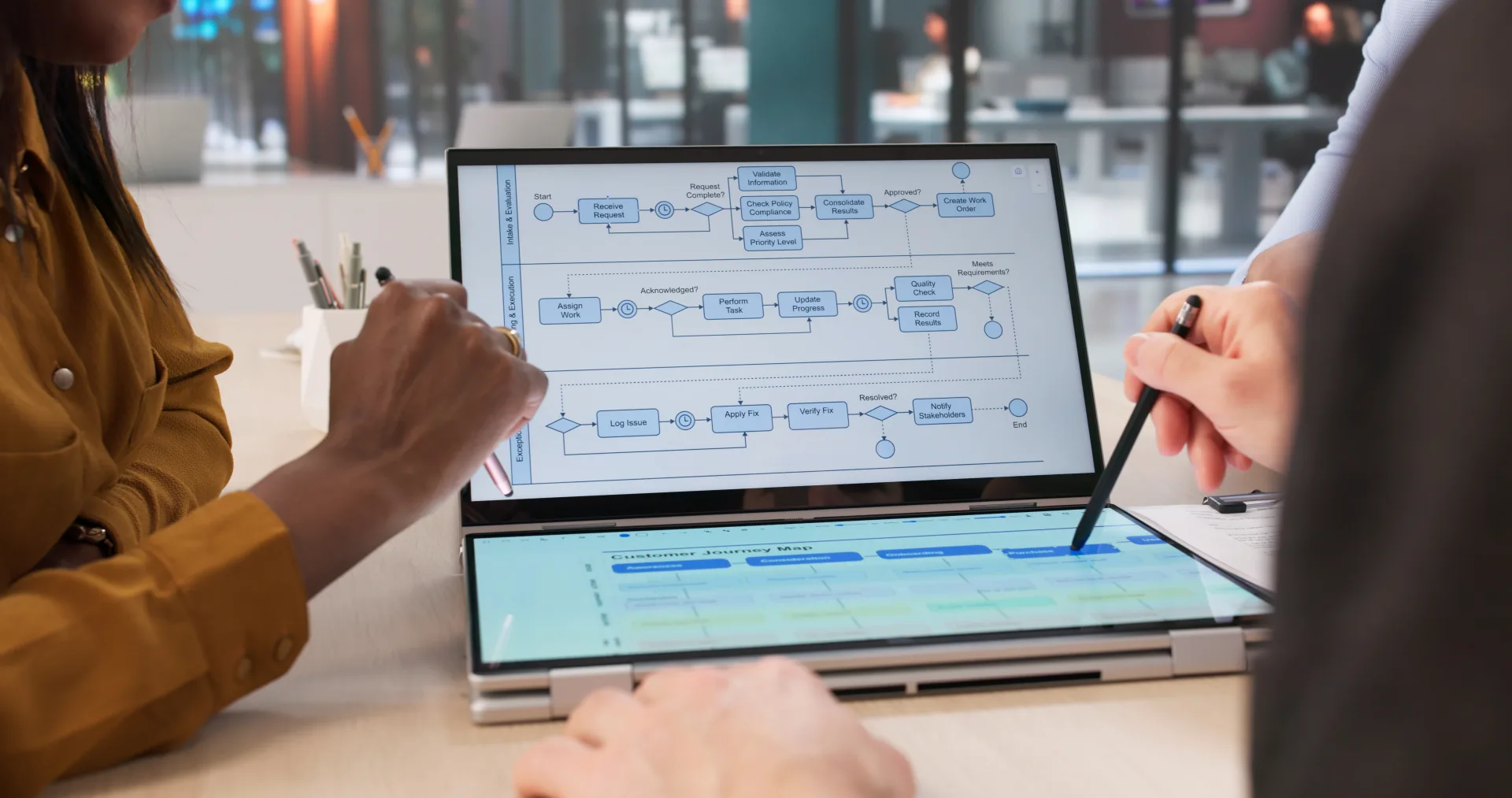
Inventory what actually exists, which is reliably not what the documentation says, then score each site on version, custom code, data volume, integrations, authentication, traffic, criticality and technical debt. The result drives sequence, test depth, rollback requirements and acceptance criteria.
Architect and build
Design the target once for the whole estate, including the cases the first pilot will not exercise, and stand it up from Infrastructure as Code so the environment is reproducible before any site depends on it.
Automate
Build the pipelines, the migration tooling and the validation before the volume arrives, not during it. This is what makes the second site cheaper than the first.
Pilot
Move representative sites, chosen because they are representative rather than because they are easy.
Migrate in waves and validate
Group by complexity and risk so each wave teaches the next, with functional, security, performance and content checks run the same way every time against a defined pass mark.
Stabilize and operate
Watch the moved sites under real traffic before calling them done, then hand over to a named operating model with monitoring, support and a patching cadence already running.
Waves are a shape, not a schedule
A wave model is a shape, not a schedule. The number of waves, what goes in them and how long stabilization takes are properties of a specific estate, and any page that tells you otherwise has not seen yours. What should not vary is the rule that rollback remains available until acceptance is confirmed.
Validation at the commit
Dependency and configuration validation, coding standards and static analysis run on the pull request, where a finding is cheap to act on.
Dependency and supply chain checks
Software composition analysis of the dependency tree. OWASP describes Dependency-Check as a tool suite that identifies project dependencies and checks whether any have known, publicly disclosed vulnerabilities.
A bill of materials and build provenance
A machine readable inventory of what shipped, and evidence of how it was built. CycloneDX describes itself as a modular and extensible framework designed to represent a broad range of supply chain information; SLSA is organized into a series of levels that provide increasing supply chain security guarantees.
Dynamic testing and an approval gate
Runtime testing against a staging environment that resembles production closely enough for the result to mean something, then a deliberate human decision before production. In Azure DevOps a pipeline is made up of stages, and control over whether a stage runs is exercised through approvals and checks.
Runtime controls
WAF, DDoS protection, TLS, single sign on, multi-factor authentication, role based access, least privilege, managed secrets and platform hardening.
Centralized logging
Application, infrastructure and security events collected where they can be correlated and retained, and routed to whatever the organization uses for security monitoring.
Observability across both halves
Infrastructure metrics and application metrics together, including Drupal health, PHP, database, cache and load balancer behavior. OpenTelemetry is a useful vendor neutral way to generate and export that telemetry, and it is worth being clear that OpenTelemetry is not an observability backend itself.
Alerting somebody has agreed to
Thresholds that page a named person, tied to a runbook that says what to look at first. An alert nobody owns is a log line with ambition.
Synthetic monitoring
Checks that exercise the journeys that matter, from outside, so a site that is technically up but functionally broken is noticed by a machine rather than a visitor.
Backup with a defined objective
NIST defines the recovery point objective as the point in time, prior to a disruption or system outage, to which data must be recovered, and the recovery time objective in terms of the maximum amount of time a resource can remain unavailable. Both are decisions, and both should be written down.
Restore rehearsal
A backup that has never been restored is a hypothesis. Rehearsal on a schedule is what turns it into a capability.
Self-service within limits
A portal or catalog can expose provisioning, deployment, backup, restore and status to delivery teams without granting infrastructure access. Backstage is one way to build it and is not required.
The LABUSA approach
LABUSA combines enterprise architecture, cloud infrastructure, cybersecurity, DevOps, Drupal platform operations and managed services to help organizations modernize complex web environments without replacing one form of vendor dependency with another.
That combination is not aspirational. LABUSA's technical capabilities span private infrastructure, public cloud, cybersecurity, enterprise architecture and AI implementation. LABUSA operates hybrid infrastructure combining privately hosted infrastructure with AWS, AWS GovCloud (US) and Microsoft Azure services, and runs privately hosted infrastructure from a carrier-neutral data center facility in the Houston area. LABUSA uses AWS to provide disaster recovery and failover capability for designated websites and web applications hosted within that private infrastructure.
LABUSA also runs Drupal, including AI-assisted Drupal work, under a rule worth stating plainly because it is the same rule this page recommends for delivery: that work is performed within a controlled development environment, and AI-assisted content is reviewed and approved by a person before it is promoted to public-facing systems.
The architecture described on this page is a reference model. It is offered as an engineering approach rather than as a description of work already delivered for any particular organization.
Related LABUSA capabilities
Drupal modernization touches most of what an IT organization already owns, so this capability is usually delivered alongside others.
- Managed IT Services, for the operating model that runs the platform once it exists.
- Security, for the controls, monitoring and response the architecture depends on.
- IT Consulting, for the assessment and target-state work that precedes a migration.
- Virtual CIO, where the decision is as much about strategy and cost as about architecture.
- AI-Powered CMS, where content operations are part of the same modernization.
- AI Infrastructure & Deployment, where the estate also has to run models.
Sources
The external statements on this page are quoted from the following, each re-read on 10 September 2026.
- Composer, Introduction, Composer documentation
- Microsoft, What is Azure Pipelines?, Azure DevOps documentation
- Microsoft, Define approvals and checks, Azure Pipelines documentation
- HashiCorp, What is Terraform?, Terraform documentation
- Drush, Drush 13 documentation
- Drush, Deploy command, Drush 13 documentation
- OWASP, OWASP Dependency-Check
- OWASP CycloneDX, Specification Overview
- SLSA, Security levels, SLSA specification v1.0
- NIST, Secure Software Development Framework (SSDF) Version 1.1, SP 800-218
- NIST, Contingency Planning Guide for Federal Information Systems, SP 800-34 Rev. 1
- OpenTelemetry, What is OpenTelemetry?
Start with the estate, not the destination
Planning a Drupal migration, cloud modernization, or platform redesign? LABUSA can help assess your current Drupal estate, define a target architecture, develop the automation and migration approach, and support the resulting platform.
The useful first conversation is usually about the estate rather than the destination: how many sites there are, what they actually depend on, which of them cannot be down, and what the organization has already decided about where its data may live.
Referenced Articles