
Solution Brief
Business Continuity & Disaster Recovery
Know how quickly your business can recover. Agree recovery objectives, build backup and recovery to meet them, and prove it works before an outage does.
LABUSA helps your organization plan for disruption and recover from it. We assess what the business depends on, agree recovery objectives with the people accountable for them, design backup and recovery to meet those objectives, and test the plan so recovery is proven before an outage, not assumed.
Solution highlights
-
Continuity Planning
Rank business functions by impact and agree who decides during an incident.
-
Backup and Recovery
Backups matched to agreed recovery points, with protected copies kept out of reach.
-
Recovery Architecture
A recovery design sized to how long each system can be down.
-
Operational Resilience
Restore tests and recovery exercises that measure how long recovery really takes.
How it works
Solution at a glance
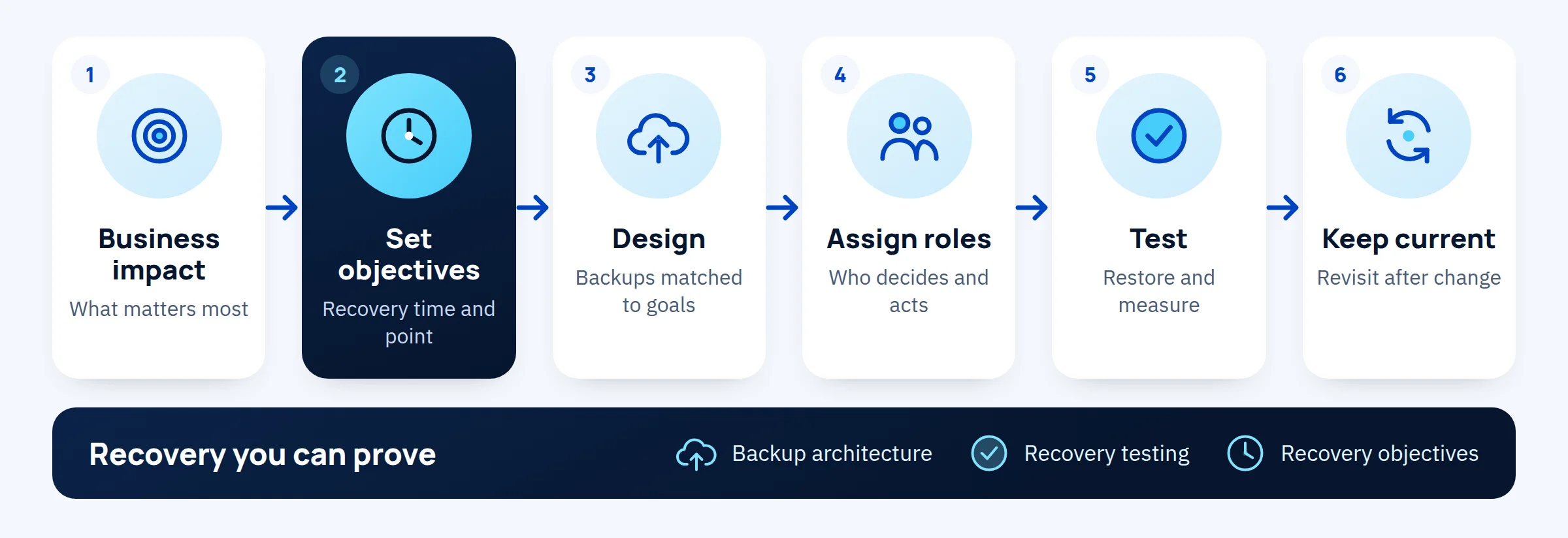
Text description of this infographic
A six-step workflow, read left to right. First, Business impact: what matters most. Second, Set objectives: recovery time and point. This step is highlighted as the point where people decide. Third, Design: backups matched to goals. Fourth, Assign roles: who decides and acts. Fifth, Test: restore and measure. Sixth, Keep current: revisit after change. Underneath, Recovery you can prove: backup architecture, recovery testing and recovery objectives.
The Business Challenge
We have backups. Can we actually recover?
Almost every organization backs up its data. Far fewer have proven they can recover it, and the gap stays invisible until an outage, a ransomware event or a regional failure exposes it. Common warning signs:
- No agreed answer to how long each system can be down
- Backups that run, but restores that are never tested
- Unmapped dependencies such as identity, DNS and third parties
- Backups the same credentials could delete
- No named owner to declare a disaster
The LABUSA Solution
Recovery planned against your requirements, then proven.
LABUSA treats high availability, backup, disaster recovery and business continuity as distinct disciplines, plans each against requirements your business has agreed, and then tests it. Professional services set the objectives and the design, and ongoing operation can continue under LABUSA managed infrastructure services where you choose. Your recovery architecture is designed for your organization, not taken from a predefined product.
-
Recovery Objectives
Recovery time and recovery point objectives set per system by the people accountable for each process.
-
Protected Backups
A backup regime that follows your recovery points, with copies no single failure or credential can reach.
-
Recovery Design
A recovery target sized to your recovery times, from a team already running AWS failover for designated websites.
-
Recovery Readiness
Restore testing and reporting on recovery readiness, not backup job counts.
How LABUSA delivers
From strategy to ongoing support.
A typical engagement follows these stages, scoped to what you need.
-
Discovery & Assessment
Assess business impact with function owners and review current backups, dependencies and restore procedures. -
Solution Design
Agree recovery objectives per system and design backup, recovery, decision roles and failback. -
Implementation
Configure backups to match recovery points, separate protected copies and prepare the recovery environment. -
Testing & Launch
Run restore tests and recovery exercises, compare measured recovery times with objectives, and hand over documentation. -
Ongoing Management
Where contracted, backup monitoring, scheduled restoration testing and recovery readiness reporting as systems change.
The Results
Expected Business Outcomes
A tested recovery plan helps you:
- Set recovery objectives the business owns
- Know how long recovery actually takes
- Spend protection budget where it matters most
- Better protect backups from attack and failure
- Make faster, clearer decisions during an incident